 Lyrics & Meaning
💡 Meaning & story
Historical Background of the Poem (When, Why and in What Context Was It Written?)
This poem was written by the people's poet Habib Jalib in 1962. At that time in Pakistan, the then-President Field Marshal Ayub Khan had introduced a new constitution after martial law, in which all powers were concentrated in the hands of a single individual and the fundamental democratic rights of the people were stripped away.
Habib Jalib flatly refused to accept this authoritarian system and this "constitution" and recited this poem for the first time at a large gathering at Mochi Gate in Lahore. The poem became so popular that it spread on people's lips overnight, and to this day it is sung and recited in every era when a voice must be raised against oppression or injustice.
Detailed Explanation of the Verses (For the Audience)
First Stanza:
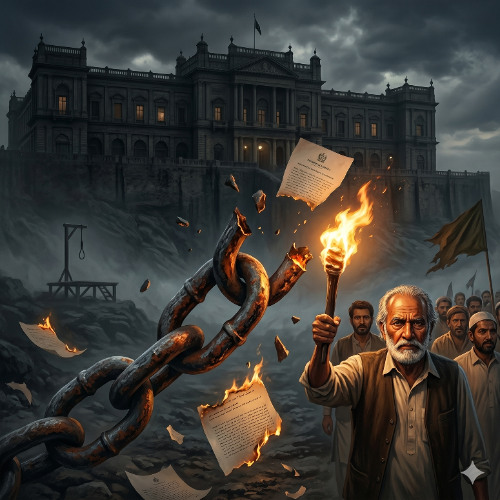
A lamp that glows only in mansions, that carries the joys of a few people—those who thrive in the shadow of every expediency—such a constitution, a lightless dawn, I do not accept, I do not acknowledge
Explanation: Habib Jalib is criticizing a system whose benefits are limited only to the elite and the wealthy. He says that a system whose "lamp" shines only in mansions and which ensures the happiness of only a few powerful people is not acceptable to me. A constitution that has been nurtured in the shadow of expedience and falsehood is not, in my view, light but rather a "lightless dawn." I refuse to accept any such system and law.
Second Stanza:
I too fear not the gallows, I too am Mansoor—tell my enemies—why do you threaten me with prison walls? The discourse of oppression, the night of ignorance, I do not accept, I do not acknowledge
Explanation: The poet declares his fearlessness. He says I have no fear of the noose of the gallows. By "Mansoor" is meant the famous Sufi saint Mansoor Hallaj, who proclaimed the truth ("I am the truth") and was crucified. Jalib says I too am a Mansoor who speaks truth; tell my enemies to stop threatening me with the cells and walls of prison. I will not bow before any talk of oppression and this dark night of ignorance.
Third Stanza:
Flowers bloom on branches, you say; goblets reach the revelers, you say; torn chests are being sewn, you say—that naked lie, the plunder of the mind, I do not accept, I do not acknowledge
Explanation: In this stanza, the false claims and propaganda of the government are mocked. The ruler of the time was giving people the impression that the country had achieved great prosperity and that everything was fine. Jalib says what does it matter what you say—that "flowers are blooming on branches" or "the wounds of the people are being healed"? This is all merely a naked lie and a conspiracy to control the minds of the people (the plunder of the mind). You may make a thousand claims, but I will never accept your lie.
Fourth Stanza:
You have plundered our peace for centuries; now your spell will no longer work on us. Why do you pose as healers of the afflicted? You are no healer. Though some may believe you, I do not accept, I do not acknowledge
Explanation: At the conclusion of the poem, Jalib addresses the oppressive rulers directly, saying that you and your class have destroyed the peace of the poor masses for centuries. But now your magic will no longer work on us. Why do you pretend to be our comforters and healers? The truth is you are tyrants, not saviors. It may be that some fall for your smooth talk, but I will never accept you as my savior.
Summary of the Message for the Audience (Presentation Note)
"This is not merely a song, but rather that powerful voice of truth and justice which once dispelled the sleep of the greatest tyrant of its time. Through this melody we are paying tribute to that fearless spirit which stands firm-breasted before oppression, tyranny and injustice. This composition, woven in harmony with both Eastern and Western instruments, is as fresh today as it was on that night in 1962 when it was first recited."