 Lyrics & Meaning
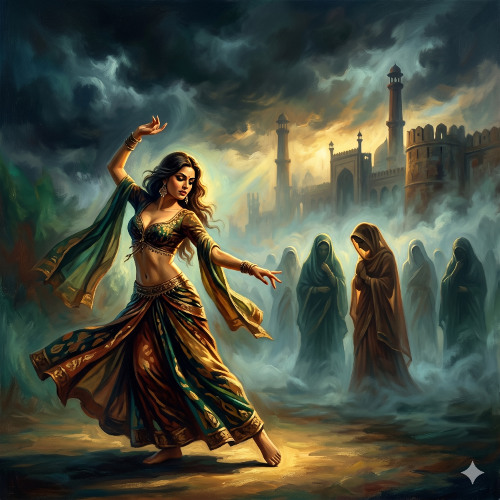
💡 Meaning & story
Poem "The Dancer": An Introduction - Written by Hafeez Jalandhari 1900-1982
This poem is not merely a tale of a dancing woman, but rather a story of the collision between East and West. Hafeez Jalandhari has employed "the Dancer" as a symbol, representing this transformed civilization that has cast aside Islamic and Eastern values.
________________________________________
Key Points and Interpretation (Key Breakdown)
1. The Civilizational Onslaught (The Cloud from the West)
The poem begins with a profound metaphor: "A cloud has risen from the West." Here, the cloud does not mean rain, but rather that storm of waywardness coming from the West, which has veiled the East's gravity and modesty. The poet presents himself as a drunkard who has lost himself in this revelry, yet whose conscience writhes in anguish.
2. Woman as Symbol and National Honor
When the poet witnesses the Dancer's audacity and semi-naked attire, he recalls the "chaste" princesses of his history.
• Contrast: On one hand there is a woman who "dances before strangers," and on the other are virtuous women who were the pride of the nation.
• Harsh tone: The poet's calling the Dancer "the Devil's daughter" is essentially an outburst of rage that seizes a man of honor watching his civilization trampled.
3. The Callousness of Men (The True Tragedy)
The poem's greatest turning point comes when the poet says: "The fault is not yours; there is no honor left in men." The poet understands that the woman's waywardness is actually the result of men's weakness and the death of national pride. When the valor of Ghazni, the magnificence of Babar, and the faith of Aurangzeb departed from hearts, the nation became mere spectators.
4. The Grandeur of the Past and the Debasement of the Present
By mentioning the "Luminous Nation," Hafeez Jalandhari reminds us that we were once those who brought light to the world, yet now "the game is nearly finished." India, which was "Paradise-like," now stands on the brink of ruin.
5. Escape and Despair
The poem's ending is deeply tragic. When the poet realizes that changing circumstances is beyond his power, he returns once again to drinking and this very dance: "Let me drink, let me drink." This is the voice of a defeated mind that seeks intoxication to escape the bitterness of reality. This phrase—"When the Day of Judgment comes, then we shall see"—expresses such profound despair that man abandons all hope of reform.
________________________________________
A Message for the Audience (The Message)
"This song is not merely a tale of dance, but rather an attempt to shake our slumbering honor awake. It shows what becomes of a nation that loses its true identity and falls into frivolity and games. Where Hafeez Jalandhari has struck at the Dancer's audacity, there too he holds up a mirror showing us that the guilty party is not she alone, but rather that society which has bartered away its honor."